Briefs, Belief and the Bar: a blog about law, faith and the long road to the Bar — written between deadlines, toy cars, family life and late-night study
“You cannot go back to a deal that no longer exists.”
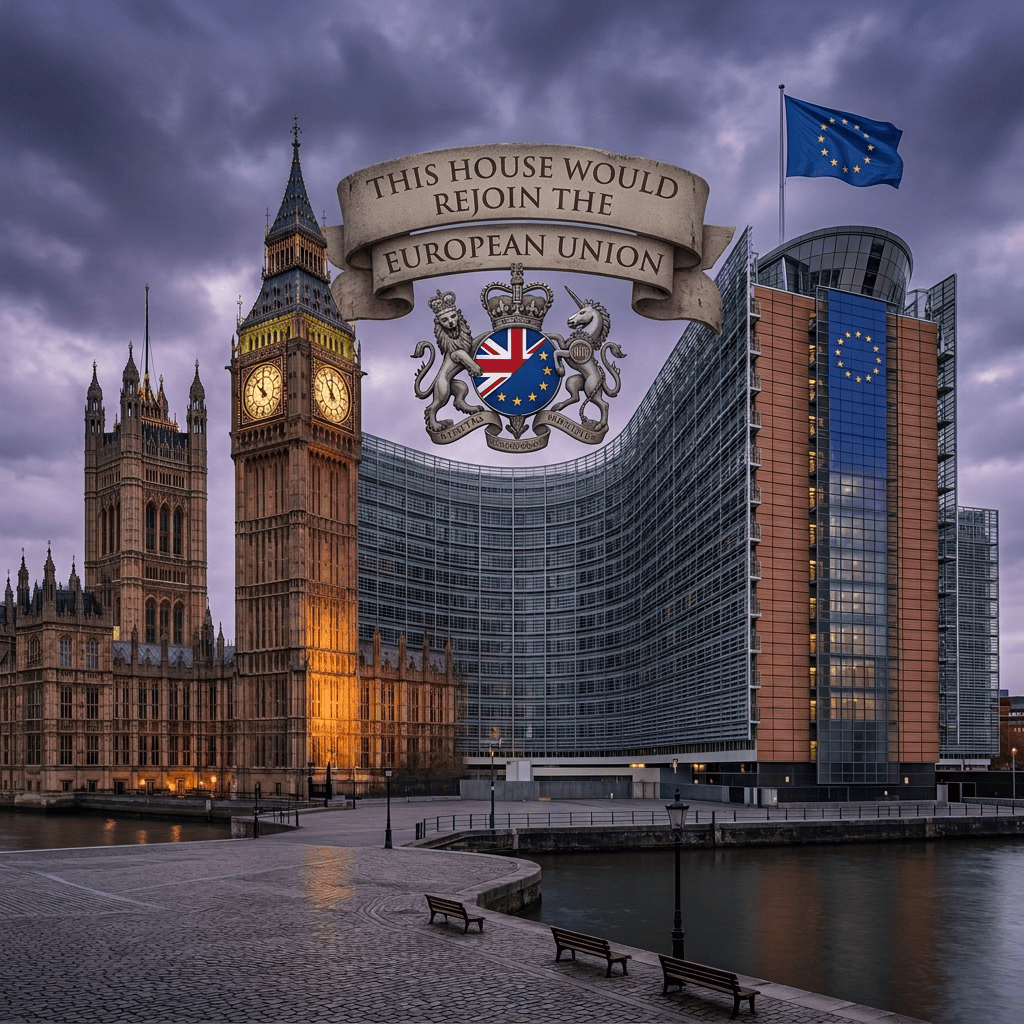
Last night, I stood up at the Lincoln’s Inn debating club to oppose the motion, “This House would rejoin the EU“.
The timing felt pointed. Two days ago, MPs debated a petition calling on the UK to rejoin “as soon as possible”, which had gathered more than 111,000 signatures.[1] The government’s answer to it was unambiguous: the UK “will not be rejoining the EU”.[1] Yet ten years after the referendum, the question clearly has not gone away.
Debating is a strange discipline for an aspiring barrister. You are handed a side, a few minutes and a room full of people who may already have made up their minds. Your job is not to win the whole argument about Britain and Europe. It is to make a clear case, stand on firm ground and leave your opponents with something they have to answer.
So I kept my case to one idea. The proposition talks about going back. But there is no going back. There is only joining again, as a newcomer, on the EU’s terms rather than ours. And on those terms, rejoining would cost us three things we once kept: our money, our currency and our borders.
Here is how I built it, and what I learned checking the law behind it.
A newcomer, not a returning member
The starting point is the Treaty itself. Article 50(5) TEU says that a state which has withdrawn and asks to rejoin “shall be subject to the procedure referred to in Article 49”.[2] In other words, Britain would not be restored to its old seat. It would apply like any other candidate country.
That matters, because almost everything special about Britain’s membership was negotiated as a member. None of it carries over.
1. Our money
In 1984, at the Fontainebleau summit, Margaret Thatcher secured the UK rebate on its budget contributions. For more than three decades it returned billions of pounds a year to the Treasury.
That rebate went when we left. A new member does not inherit an old deal; it signs up to the standard terms. Without the rebate, Britain would almost certainly pay considerably more than it did as a member, for a membership with fewer privileges than the one it gave up.
And the money is only the start, because the price of entry does not stop at our wallets. It reaches our currency.
2. Our currency
Under the Maastricht Treaty, Britain secured a protocol that meant it was never obliged to adopt the euro.[3] New members get no such thing. They join as states “with a derogation”, committed in principle to adopting the single currency once they meet the convergence criteria, which Article 140 TFEU assesses.[4]
Taken to its end, that means moving interest rate decisions from the Bank of England to the European Central Bank in Frankfurt, with the pound no longer ours to protect.
And if we are asked to commit to giving up our currency, we are asked to commit on our borders too.
3. Our borders
Britain was never part of the Schengen area. But Article 7 of the Schengen Protocol is blunt: for the purposes of accession negotiations, the Schengen rules “must be accepted in full by all States candidates for admission”.[5]
To be fair to the other side, accepting the Schengen rules is not the same as removing border checks overnight. That would require a further unanimous decision, and some states have waited many years. But the commitment would be written in from day one, and Britain would no longer be able to negotiate its way out of it as it did before.
Then there is the process itself. Under Article 49 TEU, an application requires unanimous agreement from the Council and ratification by every member state.[6] That means 27 vetoes, and 27 chances for any one government to name its price.
So we would pay more, sign up to giving up the pound and commit to Schengen, all for a seat at a table we already sat at.
The rebuttals I kept ready
Every case needs answers to the obvious comebacks. These were mine.
“Sweden has dodged the euro for decades.” Sweden is the strongest point against me, and it is worth being honest about it. Sweden has no legal opt-out. It stays out by choosing not to join the exchange rate mechanism, which keeps it from meeting one of the criteria. But it joined in 1995, before the single currency even launched, and it did so with its partners’ tolerance. Britain would be applying after walking out. It is hard to imagine the EU accepting a returning applicant whose plan for the euro is a loophole.
“The EU would offer us special terms.” Perhaps some would want to. Michel Barnier has suggested the UK might win back its euro and Schengen opt-outs.[1] But any opt-out would require negotiation, and all 27 must agree. Poland’s Foreign Minister has already said the UK would “not get the same deal as it had before”.[1]
The aftermath of Brexit: an honest ledger
A good opposition speech does not pretend the other side has nothing to say. The proposition’s strongest material is its economic record since 2020, and it deserves fair treatment.
The Office for Budget Responsibility has long assumed that leaving will reduce the UK’s long-run productivity by around 4% and its trade intensity by around 15%.[7] A ten-year review by the Centre for European Reform this June went further. It found that UK exports to the EU are roughly 12% lower than they would otherwise have been, imports about 16% lower, and business investment 12 to 18% lower by 2025. Its authors describe Brexit as a “persistent drag” on Britain’s growth rather than a sudden shock.[7]
There have been other costs too. Northern Ireland needed years of negotiation, from the original Protocol to the Windsor Framework in 2023, to manage its unique position. Students lost Erasmus+, and small exporters now face paperwork they never used to see when selling to Europe.
But the ledger has another column. Britain now sets its own trade policy. It joined the CPTPP, the Asia-Pacific trade bloc, in December 2024, and has signed deals with partners such as Australia, New Zealand and India. And the relationship with Europe has not stood still. Since the 2025 “reset”, the UK has agreed to rejoin Erasmus+ from the 2027/28 academic year as an associated country, and talks continue on an agreement for food and agricultural trade and on a youth experience scheme.[8]
That is the point I would press. The proposition treats the choice as membership or nothing. In fact, Britain is already repairing the most painful parts of Brexit, one agreement at a time, without paying the full price of re-entry.
The aftermath of rejoining
Debates about rejoining tend to talk about the destination and skip the journey. So what would rejoining actually look like?
A long road. Membership is not switched back on. An application goes to the Council, needs the European Parliament’s consent, and ends with an accession treaty ratified by every member state.[1] Some suggest the UK could be fast-tracked because its laws are still closely aligned. Even so, Finland, one of the quickest cases, took about three years.[1] Through all of that, Britain would be bringing its rules into line with the EU’s while having no vote on them.
The price of entry. This is where my three points bite. The rebate is gone. The euro and Schengen opt-outs would be up for negotiation rather than guaranteed.[1] Whatever Britain won back, it would win as a supplicant, not as the member that once set the terms.
Giving up what we have built since. Membership means rejoining the customs union, and with it handing trade policy back to Brussels. Britain’s place in the CPTPP and its independent trade deals would have to be unwound or absorbed into EU arrangements. Whatever you think of those deals, they would have been negotiated for nothing.
Reopening the wound. I suspect the deepest cost would be political. Rejoining would almost certainly need another referendum, and with it another bruising national argument. Even Prime Minister Andy Burnham, who has floated a closer relationship in the long term, has said: “the last thing we should do right now is rerun those arguments”.[1] It also seems reasonable to think the EU would want proof of lasting consensus before admitting a country that might one day leave again.
The genuine gains. In fairness, rejoining would bring real benefits. Friction on trade with our largest market would fall away, the Irish Sea border question would largely disappear, British citizens would regain the right to live and work across Europe, and Britain would once again have a vote on the rules it already follows. Those are not small things. My argument is not that they are worthless, but that returning would cost more than it ever has.
Closing
My conclusion was simple. Britain once held some of the most favourable terms any member state ever had: a rebate, an opt-out from the euro and an opt-out from Schengen. Rejoin, and we would trade them for the standard package, after years of negotiation and another national fight. The wiser path is the one already under way: rebuilding the relationship piece by piece, on terms we can still shape. You cannot go back to a deal that no longer exists.
A reflection
Whatever you think about Brexit, preparing this speech taught me something I keep relearning in my studies: the most persuasive argument is usually the one that is most precise. Each of my three points was only as strong as the treaty provision behind it, and in checking them I found places where the honest version was a little more nuanced than the punchy one. The punchy version wins a round. The honest version survives cross-examination.
That is the kind of advocate I want to become, one who is truthful about the weak points in his own case, and still makes it with conviction.
Sitting in my hotel room in Den Haag, watching the sun slowly disappear beyond the sands of Scheveningen and the North Sea, it is difficult not to reflect on what has been an intellectually stimulating and genuinely memorable week at the EDELNet LLB’s Summer School in The Hague.
View from the Novotel World Forum hotel in The Hague of the Scheveningen Beach
The waves roll steadily onto the beach below, tourists take their final evening strolls along the promenade, and the skyline begins to fade into shades of orange and gold. It feels like an appropriate setting to think about constitutions, democracy, and the rule of law in shaping societies.
Over the past week, I have had the privilege of engaging with students and academics from across Europe, exploring some of the most pressing constitutional questions of our time. The programme challenged us not only to understand constitutional law as a collection of legal rules, but also as a living framework that reflects a society’s values, aspirations, and struggles.
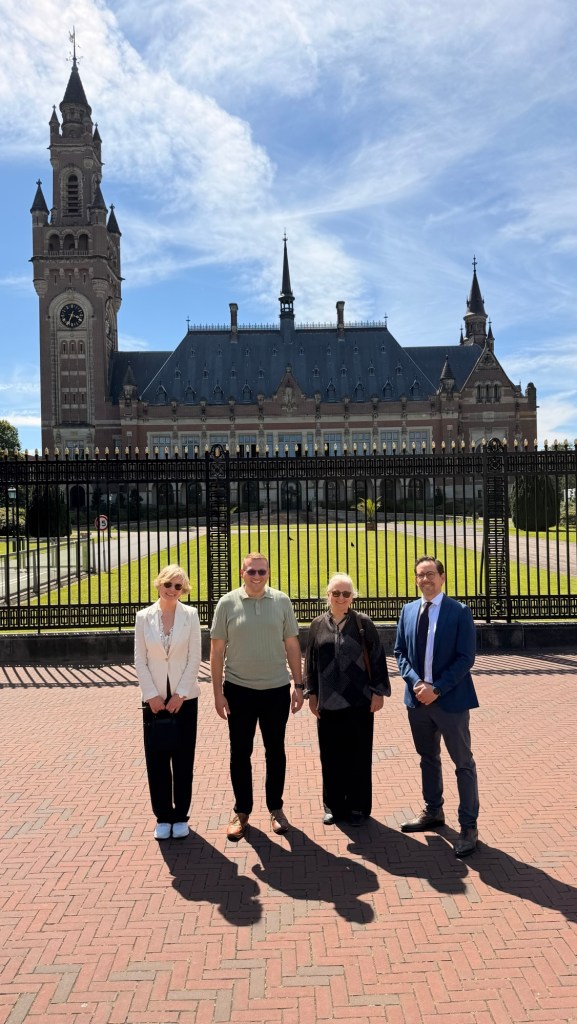
From left to right: Carla Zoethout, me, Jessica Giles and Eduardo Arenas Catalan in front of the Peace Palace, The Hague
Several lectures stood out. The session on Constitutional Courts and Militant Democracies was particularly thought-provoking. It explored the difficult balance between protecting democratic freedoms and defending democracy itself from forces that seek to undermine it. Equally compelling was the lecture on Constitutional Concepts: Brexit and the Rule of Law in Global Context, which highlighted how constitutional principles are tested by political realities and changing public expectations. Both lectures demonstrated that constitutional law is far from abstract; it remains deeply connected to contemporary political and social challenges.
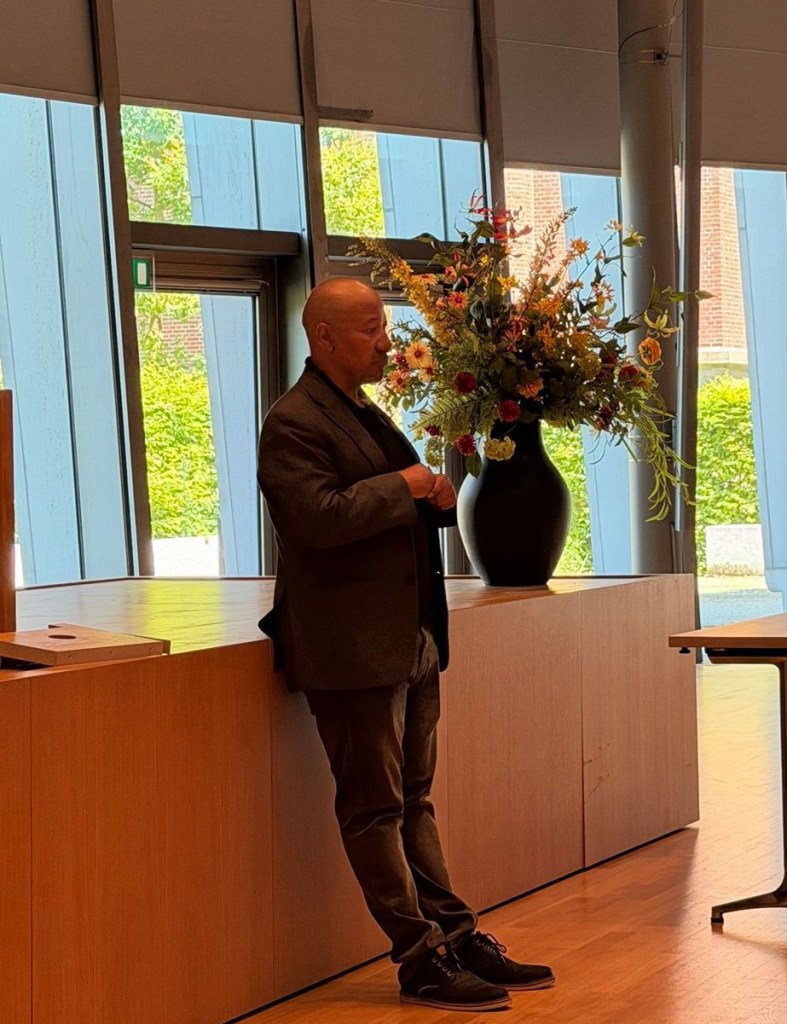
Judge Tladi with the LLB & LLM students from across Europe along with the academic staff
One of the most memorable moments of the week was the opportunity to engage with Judge Dire Tladi. Listening to his reflections on international law, judicial responsibility, and the evolving challenges facing the international legal order provided a perspective that no textbook can fully capture.
“Do what’s in front of you to the best of your ability.” Judge Tladi
What struck me most was the balance between intellectual rigour and practical experience. It was a reminder that behind every judgment, every legal principle, and every institution are individuals tasked with making decisions that affect societies and generations.
“International law is not in crisis. International Law is what it is because it’s a reflection of geopolitics.” Judge Tladi
Beyond the lectures, much of our time was spent working collaboratively on a constitutional design exercise centred on the fictional state of Inventia. At first glance, Inventia appeared to be an academic simulation. In reality, it became a fascinating exercise in constitutional imagination.
From left to right: me, Magda, Gerrit, Marisa, Lukas and Kathrin
Our group was tasked with drafting a preamble to Inventia’s new Constitution. To do this, we examined constitutional preambles from around the world, analysing how different nations express their foundational values, sources of authority, and visions for the future. We debated concepts such as sovereignty, democracy, human dignity, national identity, environmental protection, and the role of constitutional principles in uniting diverse populations.
The exercise quickly revealed that writing a preamble is about far more than choosing inspiring words. A preamble reflects a society’s history, addresses its challenges, and articulates its aspirations. In Inventia’s case, we had to consider a nation emerging from authoritarian rule, facing social tensions, and grappling with concerns about military influence in politics. Every sentence required careful thought. What values should be emphasised? How should power be limited? What message should be sent to future generations?
As law students, we often spend our time interpreting constitutions written by others. This exercise challenged us to become constitution-makers ourselves. It was an opportunity to think not only about what constitutions are, but what they should be.
Perhaps that is what I will remember most from this week: the recognition that constitutional law sits at the intersection of law, politics, history, and human aspiration. Constitutions are not merely legal documents; they are statements of collective purpose. They tell societies where they have come from, who they are, and where they hope to go.
As the last traces of sunlight disappear over Scheveningen Beach and the lights along the coast begin to shine, I find myself leaving The Hague with more questions than answers—and that is probably the greatest success of any academic experience. The Summer School did not simply provide information; it encouraged reflection, debate, and curiosity.
Before studying law, if someone had mentioned “maritime law” to me, I probably would’ve imagined old shipping disputes, cargo paperwork, or something buried deep in a legal textbook that nobody really talks about.
Now, after years working in shipping and logistics, and studying law at the same time, I’ve realised that maritime law is everywhere, especially when global tensions rise.
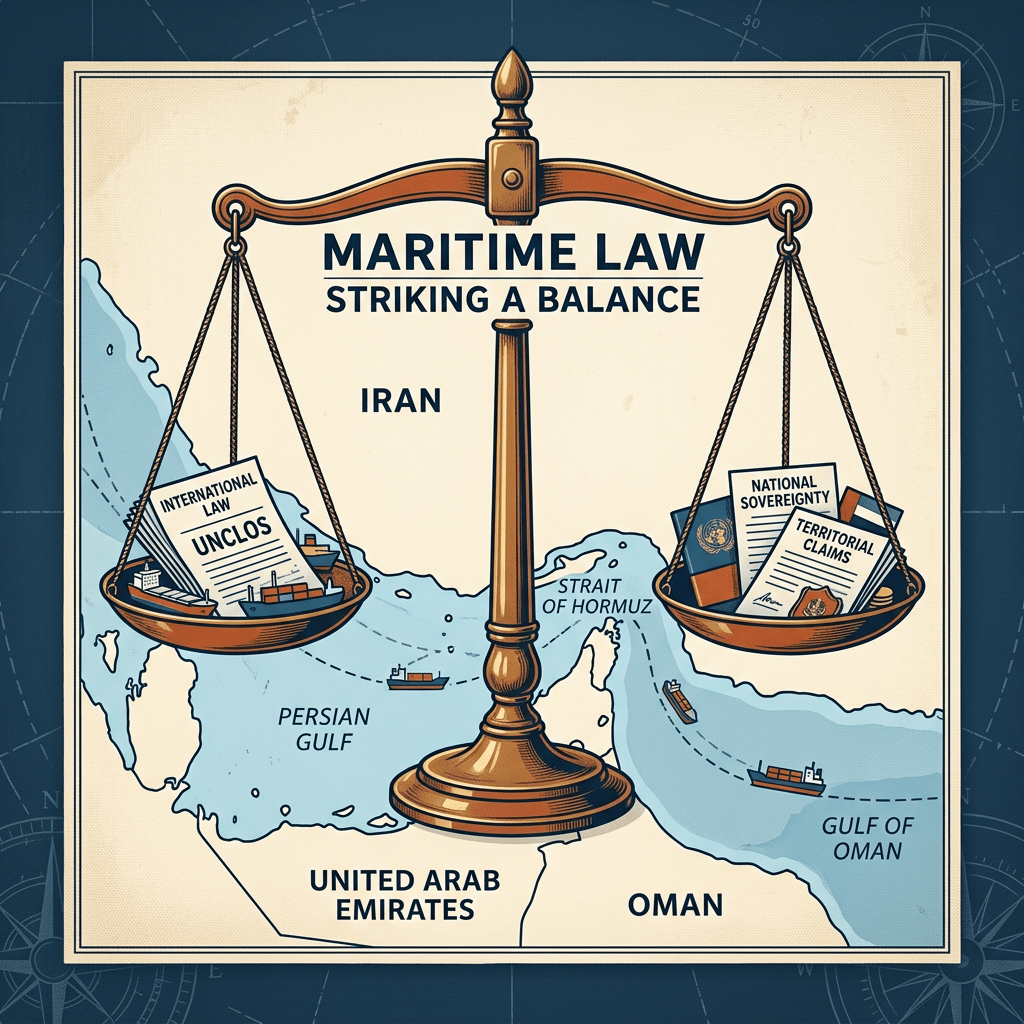
A scale illustrates the balance between international maritime law and national territorial claims in the Persian Gulf region.
Take the current situation involving Iran.
Most people understandably focus on the military side of things: missiles, politics, oil prices and headlines about escalation in the Middle East. But underneath all of that is a huge legal issue centred around one narrow stretch of water: the Strait of Hormuz.
And honestly, it’s one of the clearest examples of how law, trade and geopolitics all collide in real life.
Why everyone suddenly cares about one shipping route
The Strait of Hormuz sits between Iran and Oman. It’s not particularly large, but it carries an enormous amount of the world’s oil and gas shipments every day.
So whenever tensions rise involving Iran, shipping companies, insurers, governments and traders all start paying attention immediately.
Why?
Because if that route becomes unsafe — or worse, restricted — the effects spread everywhere:
fuel prices rise,
shipping costs increase,
supply chains slow down,
and global markets start reacting almost instantly.
What I find interesting is that this isn’t just a military issue. It’s also a legal one.
So where does maritime law come into this?
At the centre of the debate is a basic question:
Who has the legal right to control or restrict passage through the Strait?
Under international maritime law, ships generally have the right to move through important international waterways freely. The idea is simple: global trade depends on open shipping routes.
But Iran argues that parts of the Strait pass through its territorial waters, meaning it has security rights there — especially during periods of conflict.
And that’s where things get complicated.
Because suddenly you have:
international law saying shipping routes should stay open,
and a sovereign state saying national security comes first.
That tension is what makes this such a fascinating legal issue.
It gets even more complicated during conflict
Once military tensions increase, the legal questions become much more serious.
Can a country restrict access to an international strait during conflict?
Can foreign naval forces escort commercial ships?
Can tankers be stopped and searched?
What happens to neutral ships that aren’t connected to the conflict at all?
These aren’t just theoretical law-school questions anymore. They’re happening in real time.
And this is where maritime law overlaps with the law of armed conflict, which basically governs naval warfare and the treatment of civilian vessels during conflict.
Shipping reacts quickly when risk increases
One thing working in logistics teaches you very quickly is that shipping companies hate uncertainty.
The moment risk levels rise:
insurers increase premiums,
routes get reassessed,
operators delay sailings,
and contingency plans suddenly become very real.
A conflict near a major shipping lane doesn’t stay “regional” for long. It spreads through the global economy surprisingly fast.
Cargo ships navigate around a marked danger zone at sea for safety.
That’s the part people sometimes miss.
A delayed tanker somewhere near the Gulf can eventually affect:
supermarket prices,
fuel costs,
airline tickets,
manufacturing delays,
and energy bills on the other side of the world.
Everything is connected.
Law feels a lot more real when you see it happening live
One thing I’ve enjoyed most since starting my law degree is realising that law is not just statutes and cases sitting quietly in textbooks.
It’s active. It moves with the world.
You start seeing legal principles playing out everywhere:
in politics,
in business,
in shipping,
in conflict,
and even in the movement of goods across oceans.
The Iran situation is a perfect example of that.
Questions about freedom of navigation, sovereignty and international law are no longer abstract academic concepts. They’re affecting real commercial decisions every day.
Final thoughts…
The more I study law, the more I realise how interconnected everything is.
A geopolitical conflict becomes a shipping issue. A shipping issue becomes a trade issue. A trade issue becomes a legal issue.
And somewhere in the middle of all that are ordinary people simply trying to keep businesses running, families supported, and economies functioning.
That’s why I find this area so interesting. Maritime law might sound niche at first, but in reality, it sits at the centre of how the modern world operates.
And sometimes a narrow stretch of water thousands of miles away can affect almost everyone without them even realising it.
I got home from work last night, and my son was waiting for me at the front door.
Before I could even put my bag down, he asked if I wanted to come and see his fortress. In reality, the fortress was secondary. What he really wanted was simple: he wanted me to play.
The twenty minutes I spent on the living room floor, crawling through cushions, defending imaginary walls, negotiating dramatic battles, were the best twenty minutes of my day.
And yet, objectively speaking, I did not have twenty minutes to spare.
I have two assessments due next week. There are readings unfinished. Notes to revise. Deadlines to meet. Emails to answer. Career plans to build.
But in that moment, none of that mattered.
He didn’t care about deadlines. He didn’t care about emails. He didn’t care about long-term strategy or professional development.
He just wanted me.
Perspective in practice
Balancing full-time work, full-time law study, and being present as a husband and father is not easy. There are late nights at the desk. Early mornings with case law. Weekends that blur into revision sessions. A constant mental list of “next steps.”
But tonight reminded me that presence matters more.
We talk often about building a future — a career at the Bar, professional credibility, long-term security. And those things are important.
But the reason behind the ambition is not abstract. It has a face. It stands at the door. It asks you to come and see a fortress.
The windows don’t stay open
The fortress will probably be gone tomorrow.
The cushions will be back on the sofa. The assessments will get submitted. The career will continue to build.
But these invitations — these small, ordinary 20-minute windows — do not stay open forever.
One day, he won’t wait at the door. One day, he won’t need me to defend imaginary walls.
And I don’t want to look back and realise I was too busy preparing for tomorrow to show up for today.
Faith reflection
Scripture reminds us that our days are numbered, not in a way that creates fear, but in a way that sharpens wisdom. We are called to steward our time well, not just in productivity, but in presence.
It’s easy to believe that faithfulness means striving harder, achieving more, pushing further. But sometimes faithfulness looks like sitting on the floor and giving undivided attention.
God entrusts us with responsibilities, careers, ambitions, opportunities, but He also entrusts us with people.
Tonight, the wiser choice wasn’t another hour at the desk. It was entering the fortress.
The UK government is proposing one of the most significant reforms to the criminal justice system in decades: limiting jury trials for many less serious offences and replacing them with judge-only hearings in new “swift courts.” The plan would see cases likely to attract sentences of less than three years heard without juries, a move the government says is needed to tackle the acute backlog in the Crown Court and long‑standing delays in delivering justice. However, critics warn that, while framed as a simple efficiency measure, the reform risks eroding a cornerstone of English legal tradition and may do little to address the deeper causes of systemic delay.
Context: The Court Backlog Crisis
The criminal justice system in England and Wales is under unprecedented pressure. Recent reports indicate that the Crown Court backlog now exceeds 78,000 cases, with some trials listed as far ahead as 2030. This has been attributed to years of underfunding, reduced court capacity, pandemic-related disruptions, and inefficiencies in case management. Justice Secretary David Lammy has warned that, without reform, the backlog could reach 100,000 cases by the end of the decade.1
Against this backdrop, the government has revived proposals to significantly limit the use of juries for intermediate-level offences, aiming to accelerate verdicts and relieve pressure on the system.
The Proposal: “Swift Courts” and Judge-Only Trials
Under the government’s current proposals:
A new tier of “swift courts” would hear cases likely to attract sentences of three years or less, with a single judge replacing the defendant’s current right to opt for a jury trial.2
Jury trials would be reserved for only the most serious indictable offences, such as murder, rape, aggravated burglary, grievous bodily harm and other major crimes.3
Magistrates’ courts would gain expanded sentencing powers for less serious cases, allowing them to deal with a greater share of offending and ease pressure on the Crown Court.4
The government presents these reforms as essential to reducing delays and restoring public confidence in a justice system burdened by heavy caseloads. Justice officials maintain that judge-only trials will be quicker than jury trials and will limit opportunities for defendants to “game the system” by strategically seeking Crown Court jury hearings.
Historical and Legal Significance of Jury Trials
Trial by jury is deeply embedded in the legal traditions of England and Wales. Its origins are often traced to Magna Carta (1215), which sought to ensure that no person could be deprived of liberty without the lawful judgment of their peers. Legal commentators and jurists have repeatedly stressed both the symbolic and substantive importance of jury trials; Lord Devlin famously described trial by jury as “the lamp that shows that freedom lives.”5
Juries are not merely procedural devices. They secure lay participation in the criminal process and operate as a democratic check on the state’s power to punish. Critics of the proposal contend that removing jury trials for a broad range of offences would risk undermining public confidence in the criminal justice system and weakening a mode of community involvement that helps sustain the legitimacy of verdicts.6
Arguments in Support of Limiting Jury Trials
Supporters of the reform emphasize several key points:
Efficiency and Speed: The proposed “swift courts” are expected to resolve cases faster than traditional jury trials—reportedly by about 20%—because they remove the need for jury selection, instructions, and deliberation.7
Backlog Reduction: By diverting less serious cases away from full jury trials, advocates contend that the Crown Court can direct its limited resources toward complex and serious matters that genuinely require a jury, helping to relieve pressure on existing backlogs.8
International Comparisons: Proponents also reference other common law jurisdictions where non-jury trials are more prevalent, arguing that juryless systems can still yield fair outcomes when robust procedural safeguards are in place.
Judicial Transparency: Judges are trained to provide written reasons for their decisions, unlike juries, whose verdicts generally lack formal explanations. This, some scholars argue, can make judge-led decisions more transparent and analytically rigorous.9
Criticisms and Concerns
Notwithstanding the government’s rationale, the proposals have drawn sustained criticism from legal professionals, opposition politicians, and civil liberties advocates:
Undermining a Fundamental Right: Organisations such as the Law Society warn that the reforms risk eroding the fundamental right to be judged by a jury of one’s peers, a safeguard long seen as central to fairness in the criminal justice system.10
Public Confidence: Critics argue that reducing jury involvement could undermine public trust, particularly for defendants who view lay participation as reassurance of impartiality and the reflection of community standards.11
Backlog Misdiagnosed: Many legal commentators contend that the backlog is driven primarily by deeper systemic issues — including chronic underfunding, outdated infrastructure, staffing shortages, and procedural inefficiencies — rather than by the presence of juries. Without addressing these root causes, limiting jury trials may deliver only marginal gains.12
Risk of Judicial Bias: Relying more heavily on judges, as legal professionals, could intensify concerns about unconscious bias in decision-making and reduce the diversity of perspectives that juries provide.13
Balancing Efficiency and Fairness
The debate highlights a longstanding tension in criminal justice: how to balance efficiency and fairness. Prolonged delays can impose serious emotional and practical costs on victims, defendants, and their families. Yet accelerating proceedings must not come at the expense of procedural safeguards that protect liberty and sustain public confidence.
Although jury trials are not the primary source of the backlog—they represent only a small fraction of criminal cases—their symbolic and participatory value is significant. Empirical research suggests that juries help align legal outcomes with community standards and strengthen perceptions of legitimacy. Reform efforts must therefore measure the practical gains of speed against the normative importance of lay participation in criminal adjudication.
Conclusion
The UK government’s proposals to significantly restrict jury trials for less serious offences and introduce judge-only “swift courts” reflect a genuine concern about an overburdened criminal justice system. Yet, although these reforms promise greater efficiency, they have provoked controversy precisely because they touch on a fundamental aspect of English legal identity.
Whether these reforms will reduce backlogs without undermining fairness and public confidence remains uncertain. What is clear, however, is that the debate has reopened critical questions about the purpose of jury trials, the role of the courts, and the values embedded in the administration of justice in England and Wales.
Learning housing law as the Renters’ Rights Act 2025 unfolds is like studying anatomy in the middle of surgery. You work through cases, master doctrines, and memorise statutes—only for Parliament to rewrite the rules just as you’re grasping them.
As a second-year LLB student aiming for the Bar, I’ve been watching this Act with particular interest. I haven’t settled on a practice area, but housing law stands out because it impacts real people—families, single parents, young professionals, and older renters—whose day-to-day security relies on rules most have never encountered. The key legal principles we study—fairness, reasonableness, access to justice—are woven into the fabric of housing law.
This Act is more than just another law to memorise—it fundamentally reshapes how renting operates in England. It’s a powerful reminder of my motivation for studying law: real change often happens quietly, in everyday moments and private spaces, long before any courtroom debate.
Here’s how I understand the Act as a law student.
The end of ASTs and Section 21 — a seismic doctrinal shift
For decades, the private rented sector has depended on assured shorthold tenancies (ASTs), introduced by the Housing Act 1988. I’ve spent countless hours studying their development and how Section 21 enabled landlords to evict tenants without providing a reason.
The Renters’ Rights Act 2025 dismantles that structure:
ASTs are abolished entirely.
All new tenancies become periodic assured tenancies by default.
As a student of both housing and constitutional law, I find this development fascinating. Parliament is undoing one of the most significant possession powers landlords have ever held. The legal landscape is moving from landlord flexibility to tenant security—a doctrinal shift you typically encounter only in textbooks, but this time, it’s unfolding in reality.
Rent increases, rent in advance, and contract fairness
In law school we are constantly encouraged to ask: “Is this rule fair? And fair to whom?”
The Act’s reforms around rent and payments directly engage that question:
Rent increases limited to once per year and subject to tribunal challenge.
Rent in advance capped at one month for new tenancies.
Rent bidding prohibited — landlords cannot encourage tenants to outbid each other. 23
These reforms lean toward consumer protection principles. Contract law, housing law and public policy all intersect here — a perfect example of how law balances economic reality against fairness.
Housing is personal. It’s about dignity, stability, family and daily life. The Act reflects this:
Tenants gain a right to request a pet, which landlords can only refuse on reasonable grounds.
Discrimination against children or benefit-claimants (“No DSS”) is prohibited.4
These provisions go beyond technicalities—they are grounded in values. Entering the legal profession later in life, I’m reminded that law is, at its core, about people rather than paperwork.
Enforcement: database + ombudsman = access to justice in action
Public law talks endlessly about “access to justice.” This Act gives that principle real substance:
A national landlord and property database improves transparency and enforcement.
A Private Rented Sector Ombudsman gives tenants a way to seek redress without immediately entering the court system.5
For renters unfamiliar with the court system, these changes are significant. As a future advocate, I recognise how these reforms will transform the practical realities—not just the legal framework.
Energy efficiency requirements (subject to final regulations)9
As a law student, I’m most interested in seeing how these reforms play out in real life: How will the courts interpret the new grounds? Will tribunals approach rent disputes fairly and consistently? Will the database prove effective for enforcement? Will tenants truly grasp their new rights?
Experiencing a major legislative reform as it unfolds—rather than just learning about it from textbooks—has been an invaluable education.
Final Thoughts
The Renters’ Rights Act 2025 isn’t just a small revision—it represents a fundamental rebalancing of landlord-tenant law in England.
As a 41-year-old law student managing work, studies, and family, this Act reinforces my motivation for pursuing the Bar. Law has the capacity to safeguard the vulnerable, restore balance in relationships, and reintroduce fairness where it has faded.
Someday, I hope to argue possession cases, tribunal appeals, or discrimination claims based on these very provisions I’m learning now.
For the moment, I’m studying law at my kitchen table after my son’s bedtime—and witnessing it transform in real time.
Since beginning my law degree, I’ve realised that juggling studying full-time, working, and supporting my family is more than just managing time — it’s a heartfelt daily commitment full of discipline, sacrifice, and purpose.
Full-time job. Full-time law degree. Full-time husband and dad. One goal: reach the Bar without losing the things that matter most.
I’m in my second year of the LLB, working a full week in a demanding role, and I’m also a husband and a father. My study hours don’t follow the usual pattern; I’m not spending hours in a library from 10 a.m. to 4 p.m. with lecture notes and highlighters. My revision often begins when most people are winding down — after dealing with work emails, preparing dinner, and reading bedtime stories.
Some days I feel fully in control. On other days, I feel like I’m spinning plates and praying they don’t drop. But even on the difficult days, the goal remains the same:
🎯 Complete the LLB
🎯 Complete the BTC
🎯 Be called to the Bar
🎯 Secure and complete pupillage
At the heart of my academic ambitions is something even more meaningful: a sense of calling, stewardship, and legacy. I want my son to see me not just talking about discipline, purpose, and perseverance, but living them every day.
While there is a cost involved — social life becomes smaller, free time is more precious, and sleep can sometimes be a negotiation — it’s important to remember that this cost isn’t greater than the calling. If I aim to build a future as a barrister, I need to start developing the habits that will belong to that future today.
Over the next few posts, I’ll share:
How I structure my week between work, law school and family
What “realistic study discipline” looks like when life is full
How I protect time for my wife and son
Why faith is the only reason this balancing act is possible
How I stay focused on the end goal when the days feel long
If you’re also studying later in life, retraining for the Bar, juggling work and family — you’re not behind, you’re not disqualified, and you’re not alone. You’re building something with weight, with purpose, and with testimony.
Here’s to the long nights, the early mornings — and the finish line that is worth it.
“He has shown you, O man, what is good; and what does the Lord require of you but to do justice, and to love mercy, and to walk humbly with your God?” — Micah 6:8
“The core of the rule of law is that all persons and authorities within the state, whether public or private, should be bound by and entitled to the benefit of laws publicly made.” — Lord Bingham, The Rule of Law (2010)
I have spent most of my adult life in a world very different from law — over 14 years in global shipping and logistics, overseeing operations, compliance, contracts, and facing real-world pressure that never fits neatly into a textbook. It was a career that shaped me: it sharpened my problem-solving skills, taught me to lead people, and required integrity in situations where it would have been easier to compromise.
But even as I was developing that career, something else was quietly growing alongside it — a persistent pull towards advocacy, justice, and the work of the Bar. I’ve always been attracted to the discipline of argument, the precision of language, and the importance of standing up for someone who needs a voice. For years, that calling remained beside me rather than in front of me — until now.
At 41, I’m pursuing that long-held aspiration by retraining for a career at the Bar. I’m approaching it not as a school-leaver or a university graduate with an empty CV, but as a husband, a father, a Christian, and someone who understands what it means to build a life, support a family, and start afresh with purpose.
Studying law at this stage of life looks different: my case notes sit alongside toy cars, my revision sessions sometimes start after bedtime stories, and my calling is no longer just about what I will do — but who I am becoming. My faith has played a significant role in this journey. It reminds me that justice isn’t just an academic concept — it’s a command. That advocacy isn’t merely a skill — it’s service. And that careers aren’t just built — they’re stewarded.
Over the coming weeks and months, this blog will explore:
Studying law later in life and preparing for the Bar
How faith informs my understanding of justice, argument, and ethics
The realities of shifting from industry into legal training
Balancing family, calling, ambition, and discipleship
What I’m learning about pupillage, advocacy, and the legal profession
If you’re someone who’s also navigating a career shift, studying law, working toward the Bar, or trying to follow Christ in a professional world, you’re in the right place. I hope this space encourages you, challenges you, or simply reminds you that your journey doesn’t have to look like everyone else’s to be legitimate.
This is just the beginning — but it’s the right beginning.