“You cannot go back to a deal that no longer exists.”
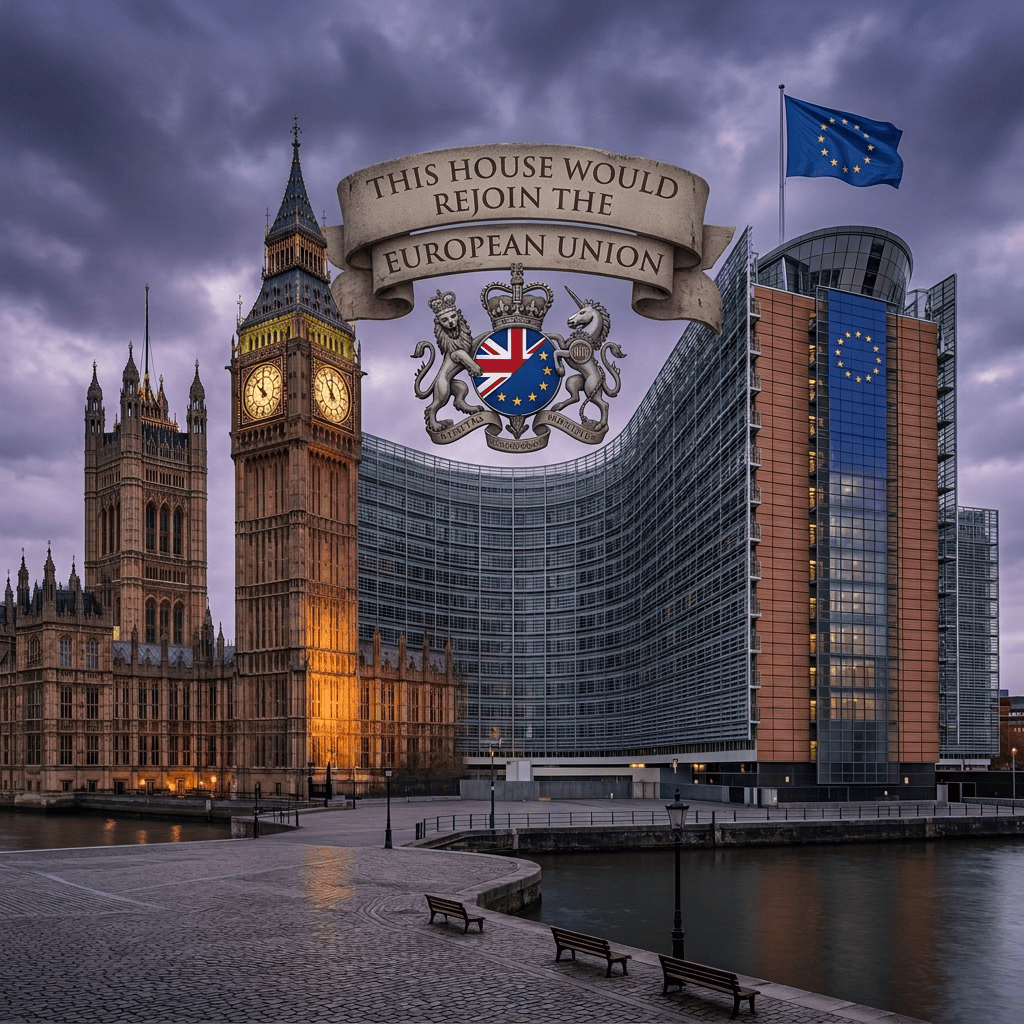
Last night, I stood up at the Lincoln’s Inn debating club to oppose the motion, “This House would rejoin the EU“.
The timing felt pointed. Two days ago, MPs debated a petition calling on the UK to rejoin “as soon as possible”, which had gathered more than 111,000 signatures.[1] The government’s answer to it was unambiguous: the UK “will not be rejoining the EU”.[1] Yet ten years after the referendum, the question clearly has not gone away.
Debating is a strange discipline for an aspiring barrister. You are handed a side, a few minutes and a room full of people who may already have made up their minds. Your job is not to win the whole argument about Britain and Europe. It is to make a clear case, stand on firm ground and leave your opponents with something they have to answer.
So I kept my case to one idea. The proposition talks about going back. But there is no going back. There is only joining again, as a newcomer, on the EU’s terms rather than ours. And on those terms, rejoining would cost us three things we once kept: our money, our currency and our borders.
Here is how I built it, and what I learned checking the law behind it.
A newcomer, not a returning member
The starting point is the Treaty itself. Article 50(5) TEU says that a state which has withdrawn and asks to rejoin “shall be subject to the procedure referred to in Article 49”.[2] In other words, Britain would not be restored to its old seat. It would apply like any other candidate country.
That matters, because almost everything special about Britain’s membership was negotiated as a member. None of it carries over.
1. Our money
In 1984, at the Fontainebleau summit, Margaret Thatcher secured the UK rebate on its budget contributions. For more than three decades it returned billions of pounds a year to the Treasury.
That rebate went when we left. A new member does not inherit an old deal; it signs up to the standard terms. Without the rebate, Britain would almost certainly pay considerably more than it did as a member, for a membership with fewer privileges than the one it gave up.
And the money is only the start, because the price of entry does not stop at our wallets. It reaches our currency.
2. Our currency
Under the Maastricht Treaty, Britain secured a protocol that meant it was never obliged to adopt the euro.[3] New members get no such thing. They join as states “with a derogation”, committed in principle to adopting the single currency once they meet the convergence criteria, which Article 140 TFEU assesses.[4]
Taken to its end, that means moving interest rate decisions from the Bank of England to the European Central Bank in Frankfurt, with the pound no longer ours to protect.
And if we are asked to commit to giving up our currency, we are asked to commit on our borders too.
3. Our borders
Britain was never part of the Schengen area. But Article 7 of the Schengen Protocol is blunt: for the purposes of accession negotiations, the Schengen rules “must be accepted in full by all States candidates for admission”.[5]
To be fair to the other side, accepting the Schengen rules is not the same as removing border checks overnight. That would require a further unanimous decision, and some states have waited many years. But the commitment would be written in from day one, and Britain would no longer be able to negotiate its way out of it as it did before.
Then there is the process itself. Under Article 49 TEU, an application requires unanimous agreement from the Council and ratification by every member state.[6] That means 27 vetoes, and 27 chances for any one government to name its price.
So we would pay more, sign up to giving up the pound and commit to Schengen, all for a seat at a table we already sat at.
The rebuttals I kept ready
Every case needs answers to the obvious comebacks. These were mine.
“Sweden has dodged the euro for decades.” Sweden is the strongest point against me, and it is worth being honest about it. Sweden has no legal opt-out. It stays out by choosing not to join the exchange rate mechanism, which keeps it from meeting one of the criteria. But it joined in 1995, before the single currency even launched, and it did so with its partners’ tolerance. Britain would be applying after walking out. It is hard to imagine the EU accepting a returning applicant whose plan for the euro is a loophole.
“The EU would offer us special terms.” Perhaps some would want to. Michel Barnier has suggested the UK might win back its euro and Schengen opt-outs.[1] But any opt-out would require negotiation, and all 27 must agree. Poland’s Foreign Minister has already said the UK would “not get the same deal as it had before”.[1]
The aftermath of Brexit: an honest ledger
A good opposition speech does not pretend the other side has nothing to say. The proposition’s strongest material is its economic record since 2020, and it deserves fair treatment.
The Office for Budget Responsibility has long assumed that leaving will reduce the UK’s long-run productivity by around 4% and its trade intensity by around 15%.[7] A ten-year review by the Centre for European Reform this June went further. It found that UK exports to the EU are roughly 12% lower than they would otherwise have been, imports about 16% lower, and business investment 12 to 18% lower by 2025. Its authors describe Brexit as a “persistent drag” on Britain’s growth rather than a sudden shock.[7]
There have been other costs too. Northern Ireland needed years of negotiation, from the original Protocol to the Windsor Framework in 2023, to manage its unique position. Students lost Erasmus+, and small exporters now face paperwork they never used to see when selling to Europe.
But the ledger has another column. Britain now sets its own trade policy. It joined the CPTPP, the Asia-Pacific trade bloc, in December 2024, and has signed deals with partners such as Australia, New Zealand and India. And the relationship with Europe has not stood still. Since the 2025 “reset”, the UK has agreed to rejoin Erasmus+ from the 2027/28 academic year as an associated country, and talks continue on an agreement for food and agricultural trade and on a youth experience scheme.[8]
That is the point I would press. The proposition treats the choice as membership or nothing. In fact, Britain is already repairing the most painful parts of Brexit, one agreement at a time, without paying the full price of re-entry.
The aftermath of rejoining
Debates about rejoining tend to talk about the destination and skip the journey. So what would rejoining actually look like?
A long road. Membership is not switched back on. An application goes to the Council, needs the European Parliament’s consent, and ends with an accession treaty ratified by every member state.[1] Some suggest the UK could be fast-tracked because its laws are still closely aligned. Even so, Finland, one of the quickest cases, took about three years.[1] Through all of that, Britain would be bringing its rules into line with the EU’s while having no vote on them.
The price of entry. This is where my three points bite. The rebate is gone. The euro and Schengen opt-outs would be up for negotiation rather than guaranteed.[1] Whatever Britain won back, it would win as a supplicant, not as the member that once set the terms.
Giving up what we have built since. Membership means rejoining the customs union, and with it handing trade policy back to Brussels. Britain’s place in the CPTPP and its independent trade deals would have to be unwound or absorbed into EU arrangements. Whatever you think of those deals, they would have been negotiated for nothing.
Reopening the wound. I suspect the deepest cost would be political. Rejoining would almost certainly need another referendum, and with it another bruising national argument. Even Prime Minister Andy Burnham, who has floated a closer relationship in the long term, has said: “the last thing we should do right now is rerun those arguments”.[1] It also seems reasonable to think the EU would want proof of lasting consensus before admitting a country that might one day leave again.
The genuine gains. In fairness, rejoining would bring real benefits. Friction on trade with our largest market would fall away, the Irish Sea border question would largely disappear, British citizens would regain the right to live and work across Europe, and Britain would once again have a vote on the rules it already follows. Those are not small things. My argument is not that they are worthless, but that returning would cost more than it ever has.
Closing
My conclusion was simple. Britain once held some of the most favourable terms any member state ever had: a rebate, an opt-out from the euro and an opt-out from Schengen. Rejoin, and we would trade them for the standard package, after years of negotiation and another national fight. The wiser path is the one already under way: rebuilding the relationship piece by piece, on terms we can still shape. You cannot go back to a deal that no longer exists.
A reflection
Whatever you think about Brexit, preparing this speech taught me something I keep relearning in my studies: the most persuasive argument is usually the one that is most precise. Each of my three points was only as strong as the treaty provision behind it, and in checking them I found places where the honest version was a little more nuanced than the punchy one. The punchy version wins a round. The honest version survives cross-examination.
That is the kind of advocate I want to become, one who is truthful about the weak points in his own case, and still makes it with conviction.


Leave a Reply